Outside of school (which seems like forever ago), it is surprisingly difficult to keep learning across topics in a way that actually sticks. For as long as I can remember, I’ve been told that everything I could ever want to know is on the internet, yet without a real thread connecting what I read today to what I wondered about last month, my curiosity quickly turns to half-baked thoughts and a lot of articles I once meant to read.
When ChatGPT released “Deep Research” over a year ago, I was through the roof excited: I finally had an “easy” way to generate detailed research packets about any topic I was interested in. However, my excitement for the new feature soon vanished as I realized the AI has amnesia: every new Deep Research task starts from a blank slate, without any regard for the notes I’ve jotted down in my pocket notebook or the ideas I’ve already explored. Because these large language models don’t actually know me, the output always felt like generic academia that was not at all personalized for how I think or learn.
After experiencing this issue for over a year, I stopped asking one-off questions and instead built a research system around a living map of everything I’ve read, written, and wondered about.
Turning Notes into a Map of Meaning
Normally, when I save notes on my computer or Google Drive, I put them in folders under the main topic they cover (e.g. History, Psychology, Science). I am a very organized person and the thought of a computer without organized structure freaks me out. Folders provide structure, but they also build walls between notes and information that live in other folders. A note I wrote a year ago about my life aspirations sits in my Life folder, which is completely isolated from a note in Meditation focused on my previous misconception of the linearity of time (there is no past, there is no future… there’s just now). These two topics could certainly be interconnected, but in their current form, they are siloed.
To overcome these manufactured walls, I utilized a quiet superpower that exists within modern AI: embeddings. Instead of filing a paragraph by its title or folder, embeddings are able to turn the meaning of that note or paragraph into coordinates. Notes that have similar topics begin sitting right next to each other because they share similar coordinates, even if they don’t share a single matching keyword.
To create this embedding system, I fed over 700 notes across deep research topics onto a map, which broke those notes into ~33K bite-sized passages stored in a vector database. Instead of scanning for exact keywords, the vector database searches across all of the passages by meaning, enabling any new research topic to instantly pull the most relevant paragraphs from existing notes and research. The power here is that a research topic in one field might unexpectedly connect closely to a note in a completely different field, and that bridge itself gets embedded as its own vector inside the graph. The system isn’t just indexing isolated chunks, it’s indexing the relationships between ideas. This system continues to improve and learn, simultaneously bringing to life cross-subject connections that I alone would have been unable to discover.
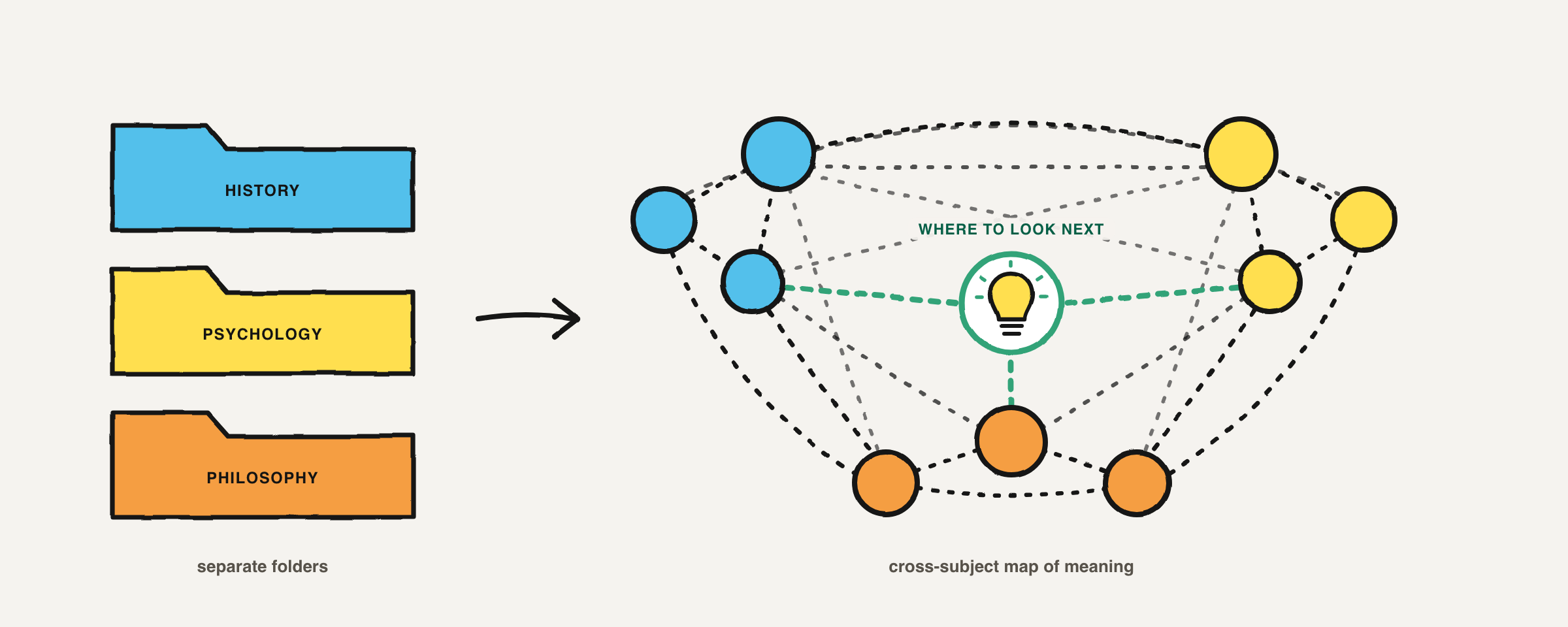
Every time this research system finishes researching a topic, it saves the biggest unanswered questions to the map. As seen in the graphic above, when completely separate subjects independently bump into the same open question from opposite “sides” of the map, that spot on the map “lights up” and indicates to the autonomous research agent that this is the next research topic to investigate.
Hyper-Focused With No Echo Chamber
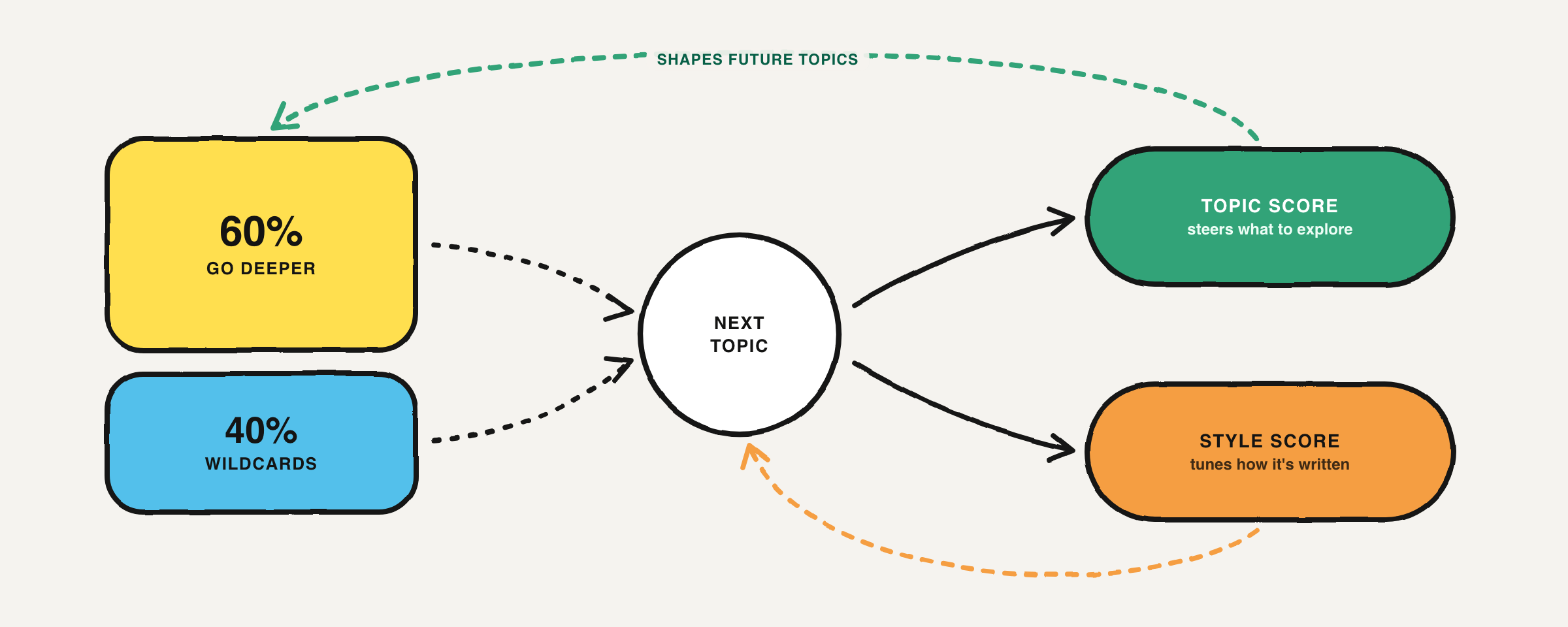
As I think we can all attest, the problem with modern algorithms driving recommendation engines is that if you click on one thing out of curiosity, the algorithm will automatically feed you ten different clones of that exact thing until suddenly your whole feed is now filled with that specific (sometimes unwanted) topic. To keep my research system hyper-focused on my interests without trapping me in a self-imposed algorithmic bubble, every new topic that the agent researches is chosen using a 60/40 explore-exploit balance. 60% of the time, I want the system digging one layer deeper into a specific topic that I’ve tasked it with better understanding. I have these topics set up on two-week “sprints”, where over the course of that time, the system will continue diving deeper by leveraging the existing embeddings focused on that topic. The remaining 40% of the research is purposefully dedicated to fresh topics that deliberately venture into the untouched corners of the map. These topics include unfamiliar subjects I haven’t explored yet, but ones that the agent thinks I might be interested in.
One simple feedback trick that I’ve instilled in the system is the ability to respond to what the research unveiled across two decoupled reinforcement learning scores: a topic reward (did I love the subject?) and a format reward (did I like how it was written?). If the system reveals a fascinating story but it’s written in dry language, I can reply that it was too dense and difficult to follow, but I loved the topic. Alternatively, I could respond that the new topic it just researched was of no interest to me, in which case it would know to steer clear of similar topics. The system embeds that feedback onto the same map, adjusting both what it researches next and how it writes until it fits the exact way I think and learn.
A Continuous Loop
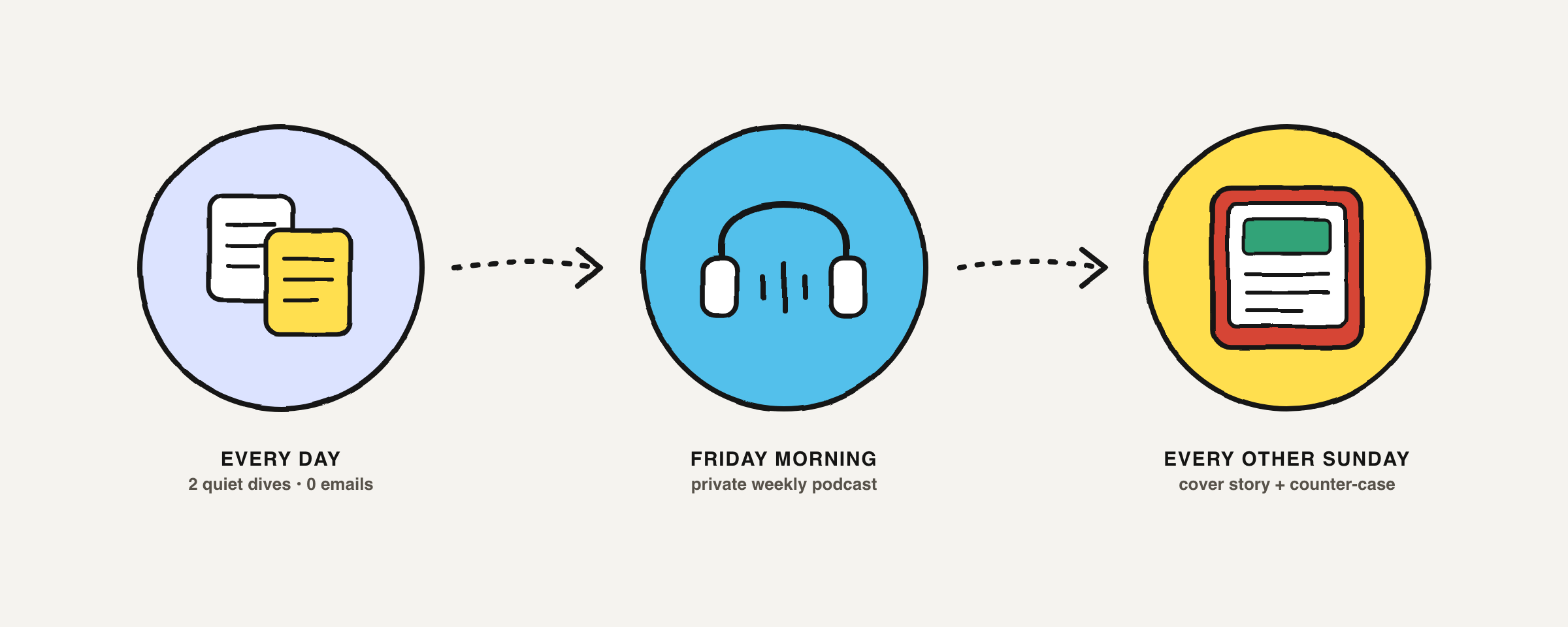
The point of all this intelligence is a more thoughtful life, one that enables me to be human and have information available to learn when I want it without the need to constantly be tethered to my computer. I’ve found that the fastest way to ruin a learning habit is to constantly receive generic AI-generated summaries in my inbox, as it very quickly starts to feel like homework that I archive rather than read. To solve this sense of fatigue, I created three different layers that quietly run in the cloud without constantly interfering in my daily life.
Every Day: twice a day in the background, the system researches two focused questions based on the existing graph and embeds the new findings straight back onto the map.
Friday Mornings: once a week, the system pieces together the clearest discoveries and connections into a natural spoken “podcast” created with TTS (text-to-speech) models that automatically drops straight into my Apple Podcasts app via an RSS stream.
Every Other Sunday: the research agent edits the best of the notes it’s compiled in the last two weeks and summarizes them into short, magazine-style articles, ending with a “cover story” based on the single best cross-subject thread.
Using AI to Be More Human
Most of the conversations around AI right now are about how we can skip reading and get to the main point faster. What excites me about building these types of systems is the exact opposite: using a living map of memory to connect fragmented ideas, push back on my own biases, and unveil topics and questions that force me to think more in my free time. This system enables me to continue asking questions, but not be tied to the device that otherwise serves as a distraction. Any one of these outputs could be printed, and I could review them with paper and pen if I wanted. They are mine to keep, and I get to consume that information without the constant influx of ads that you’d find in a modern podcast or newsletter.
The real power of AI isn’t automating away my curiosity. It’s that I can now build a personal system shaped around how my unique mind works, filling my world with continued curiosity in a way that makes me feel even more human.
If you’re curious how it’s wired under the hood, the whole thing runs serverless in Google Cloud at essentially zero extra cost beyond my existing Gemini subscription: notes and embeddings live in a personal BigQuery database (which handles embeddings and vector search out of the box), scheduled cloud runs handle the daily research and skeptical review, and a custom Cloud Run MCP server (with stateless OAuth) lets me query or steer everything from my phone. Feel free to reach out if you’d like to chat about building something similar.